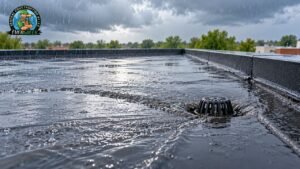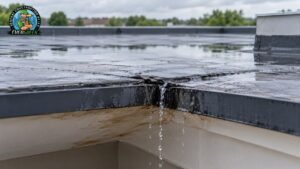
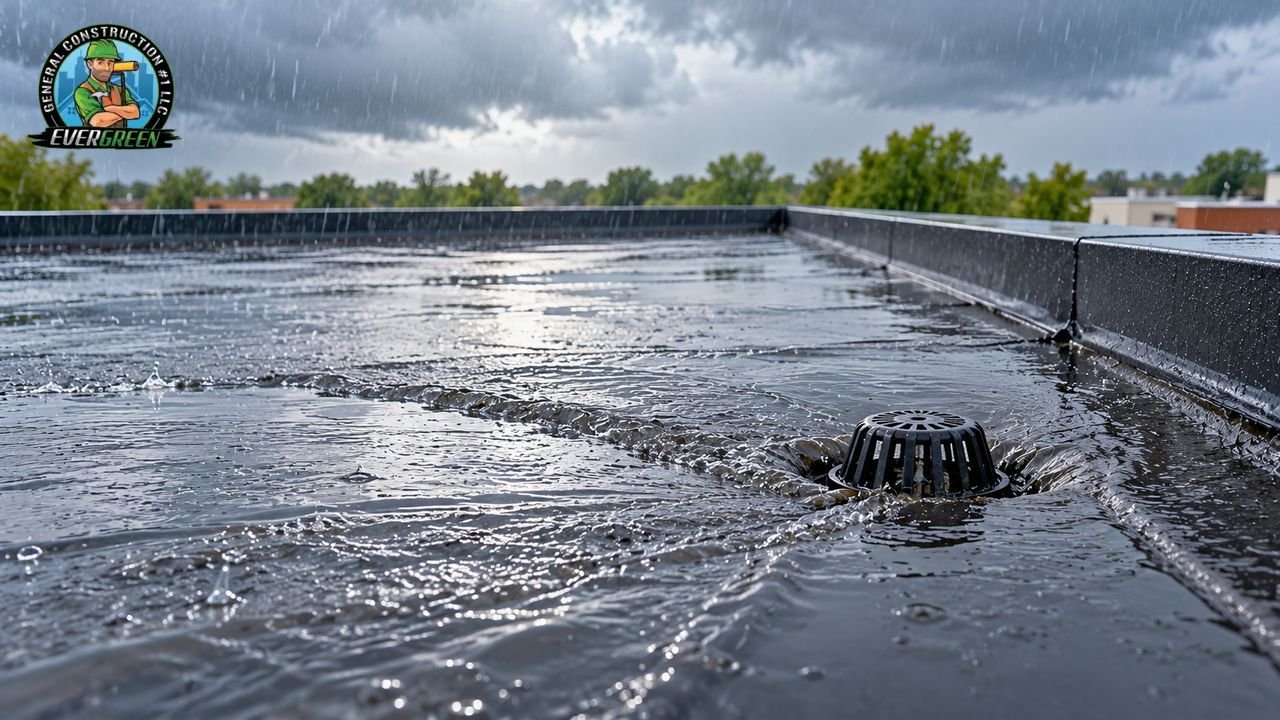
A common cause of flat roofing Puyallup WA homeowners replacing their roof years earlier than they should be is when the water remains on the roof 48 hours after the rain ends. A pitched roof allows water to run off by gravity.
A low slope roof barely does, so all drains, seams and flashings must take the load and the wet season of Puget Sound puts them to the test. Annual precipitation at a nearby airport, Sea Tac, which is just over 20 miles north of Puyallup, was 39.34 inches per year according to NOAA’s 1991–2020 normals, most of which occurred from October through March.
This guide explains how rain and drainage damage low slope roofs, how to tell ponding from a true leak, and what fixes cost. It’s from the people at Evergreen General Construction #1 LLC, who have over 25 years of experience in the construction industry in Puyallup, Tacoma and Auburn. If you believe that you have a problem, our flat roofing services page discusses inspections, repair and replacement.
Why Puyallup Rain Is Hard on Low Slope Roofs
Weeks of soaking rain and a few major storms are the problem with Puyallup rain on flat roofs. The membrane can remain moist from November to January if it is able to stay moist between the July showers.
November averages approximately 6.3 inches of precipitation at Sea Tac, while July averages approximately 0.6 inches of precipitation, which is approximately one-tenth as much.
With any flat roofing Puyallup WA job, one should consider this calendar as a deadline. Repairs made between June and September bond to dry material. Repairs started in November often get a temporary patch and wait for spring.
Local trees add to it. The leaves, seeds and needles of bigleaf maple, red alder and Douglas fir wash to the lowest spot on a roof, where the drain is located. The clogged scupper is most likely to be on a flat roof that Puyallup WA owners inherited with the house that no one has ever inspected since closing day!
Flat Roof Drainage Puyallup WA: How Water Should Leave the Roof
A slope of at least a quarter inch to every foot (2 percent pitch) is required for a flat roof so that water drains to a drain scupper or edge and does not collect. The roofers do not regard water that remains on the roof for 48 hours after the rain ceases as a rain problem.
The 1/4” minimum is required by the International Building Code (IBC) for built up, modified bitumen and single ply membranes. The International Code Council’s 2019 code hearing records add two details worth knowing: any roof section flatter than a quarter inch per foot is a “susceptible bay” that must be checked for ponding instability, and a roof at an eighth inch per foot backs up twice as much water as one at a quarter inch. Washington builds its state code on the International Codes, so those numbers are the starting line here.
Good flat roofing Puyallup WA work is a water routing plan with a membrane on top. The membrane keeps water out. The slope, drains and overflow decide whether it ever has to.
When we trace flat roof drainage Puyallup WA problems back to their cause, it is usually one of four things:
- A low spot where the deck has sagged or the insulation has compressed
- A drain or scupper set higher than the surrounding membrane
- Debris blocking the outlet, which is a maintenance failure, not a design flaw
- No overflow route, so a blocked main drain on a parapet roof lets water keep rising
| Blue Tip: Two days after a good rain, look at the roof from a window or a ladder at the eave and photograph any water still sitting. Never walk a wet membrane. Photos a month apart show whether a pond is growing. |
Rain Damage Flat Roof Puyallup WA: What Wet Months Do to a Membrane
A low slope roof suffers damage in three layers seams, insulation under the membrane and the roof deck itself with the damage to the seams and the insulation underneath the membrane being the most common cause of issues. The membrane doesn’t often fail to begin with. It has no effect where water comes into contact with a weak spot.
Water doesn’t break down a membrane, but water kept in seams and edges for weeks and weeks will keep them wet. A seam that is wet all winter will eventually split open.
Once water gets under the membrane it spreads sideways through the insulation, which behaves like a sponge. Wet-insulation degrades its R-value, compresses underfoot, and allows the membrane to stretch beyond its limits, ultimately leading to it tearing. That is why there is sometimes a 10 foot gap between the actual opening and a ceiling stain. Many inspections of flat roofing in Puyallup WA reveal that the membrane is in good condition, and the condition of the wet insulation determines whether or not the roof is repaired or replaced.
In addition to growing things, Puget Sound roofs grow food. Roof surfaces do not dry out in the presence of moss and algae, and tall evergreens are the worst offenders because their shade reduces drying. Saturation is more harmful than ice here, and on the east side of the Cascades, as January lows are in the low 30s and are generally not as cold here, freeze-thaw is less significant.
People who search rain damage flat roof Puyallup WA are usually looking at a ceiling stain, and by then the insulation has typically been wet for a while. Take dated photos of the stain and any standing water before repairs begin, for insurance.
Where Water Actually Gets In
Almost all flat roof leaks originate from a detail not from the open field of the roof membrane. Most entry points are penetrations, wall flashings, drains and seams, and the stain in the house will be far from the actual entry point, often feet away.
Water will follow the deck and the insulation as well, so water that fell down will be on the ceiling, not water that got in.
| What you see | Likely cause | First thing to check |
|---|---|---|
| Stain two or three days after rain | Ponding or wet insulation releasing slowly | Standing water 48 hours after rain |
| Drip within an hour of rain starting | Failed flashing or penetration | Pipe boots, skylight curbs, wall flashing |
| Stain along an exterior wall | Open wall termination or counterflashing | Sealant, termination bar, cladding above |
| Leak only in wind-driven rain | Lifted edge metal or perimeter flashing | Drip edge, fasteners, coping joints |
| Soft spot underfoot | Saturated insulation or rotted deck | Moisture scan before any patch |
One of the most common issues flat roof leak repair Puyallup WA contractors receive involves ponding that is actually disguised as a leak. Many of the repairs for flat roof leaks Puyallup WA homeowners seek are actually just seams that have been damp for too long. If the cause is not readily apparent, a moisture scan using either infrared or capacitance can be used to map out wet insulation without making any cuts.
If after a patch a leak comes back, then the patch was treating a symptom. Ask any roofer repairing flat roofing Puyallup WA leaks to show you where water entered and how they confirmed it.
| Blue Tip: Note the date and the weather each time a stain grows. If the leak appears within 2 days of rain, it is an indication of ponding or wet insulation. One that appears within an hour points to a flashing or penetration. |
Choosing a Membrane for Constant Rain
For Puyallup’s wet winters, heat welded TPO or PVC, fully adhered EPDM and layered modified bitumen are the systems that hold up when drainage is sound. A roof that retains water will not be forgiven by none of them.
Low slope roofing in Puyallup WA requires membrane due to the need for continuous seams to be sealed to exclude water rather than overlapped. Under the International Building Code, asphalt shingles can only be used on slopes of 2:12 (or steeper). Therefore, any roof with a slope lower than 2:12 (3:4) requires one of these systems.
| Membrane | Seams | Est. installed cost per sq ft | Typical life | Rain note |
|---|---|---|---|---|
| EPDM | Adhered sheet, taped or glued seams | $6 to $10 | 20 to 25 years | Large sheets mean fewer seams, which need dry surfaces to bond |
| TPO | Heat welded | $7 to $12 | 15 to 25 years | Reflective white surface; welds hold when drains stay clear |
| PVC | Heat welded | $9 to $14 | 20 to 30 years | Premium price, strong welds, chemical resistance |
| Modified bitumen | Layered sheets, torched or adhered | $7 to $12 | 15 to 20 years | Redundant layers; needs a dry window and strict fire safety |
Estimates for residential scale roofs, before tear off and tapered insulation. A site visit sets the real number.
As far as material, it’s not that important as most owners think since a TPO ponding roof and PVC ponding roof both fail the same way. A long-lasting roof requires a slope plan: Tapered insulation, crickets (behind curbs and chimneys), drains at low points. Most quotes for flat roofing Puyallup WA projects mention a membrane and a square footage, but fail to mention the slope which is where the ponding comes back in.
Flat Roof Repair Puyallup WA: Patch, Fix the Slope, or Replace
If damage occurs to a flat roof and the insulation under the roof is dry then patch the roof. Remove when the same low area is still failing and/or a moisture scan reveals damp insulation over about 1/4 of the roof or more.
It’s not a code; it’s our working rule. Beyond that, water is chasing repairs on the roof and patching costs are rising towards replacement costs. The most common DIY flat roof repair Puyallup WA people call in to have undone is sealant that smears over a seam, which prevents the actual repair.
| Work | What it solves | Estimated cost |
|---|---|---|
| Clear drains and scuppers | Blocked outlets, shallow ponding | $150 to $350 |
| Reseal a seam, flashing, puncture, or blister | Open lap, cracked pipe boot, local damage | $300 to $900 |
| Add an overflow scupper | No backup exit on a parapet roof | $500 to $1,000 |
| Moisture scan | Locates wet insulation | $400 to $1,200 |
| Tapered insulation | Recurring pond | $2 to $5 per sq ft treated |
| Full replacement, TPO or EPDM | End of life or widespread wet insulation | $6 to $12 per sq ft, plus $1 to $3 tear off |
Estimates for typical residential jobs. Scope and price are confirmed at a site visit.
For scale, a 400 square foot roof over a garage or addition runs about $2,400 to $4,800 for the membrane, plus $400 to $1,200 for tear off, or roughly $2,800 to $6,000 all in. There are two costs to consider for flat roofing Puyallup WA repairs: The repair itself, and the drainage change to prevent the problem from occurring again.
| Blue Tip: Inquire of each bidder where the water goes when they’re done. A solid answer names drain locations, slope and overflow. |
A Maintenance Calendar for the Wet Season
In early October, prior to the first soaking storm, clear all drains and scuppers and again after wind storms that blow the trees. Check seams and flashings in March – after the wettest months.
- October: Clean up leaves and needles from drains, scuppers and gutters; cut back tree branches above roofs.
- Clean up debris dams, standing water and loose edge metal from a window or ladder after windstorms or in January:
- April: Test seams, flashings, pipe boots and wall joints for leaks; take photos of roof surface
- June – September: Do repairs, coatings & replacements during dry conditions
Maintenance is the cheapest line in flat roofing Puyallup WA ownership. A drain cleaning that costs a couple hundred dollars is cheaper than one wet insulation panel, and a coating can extend a sound but aging roof if the insulation below is dry.
Flat Roof Questions Answered
What are the downsides of having a flat roof?
Flat roofs can hold water longer, have more seams and details that can fail and require more frequent inspections than pitched roofs. Leaks are more difficult to locate as water flows beneath the membrane and only becomes apparent when water appears. The tradeoffs are a clean modern profile and usable roof area.
What is the best roofing option for a low slope roof?
Because shingles are not allowed on slopes less than 2:12, a single ply membrane (TPO, EPDM or modified bitumen) is the option. For flat roofing in Puyallup WA homes and buildings we install TPO and EPDM. The heat welded seams are provided by TPO and the large sheets are supplied at a lower cost by EPDM. The brand isn’t that important, it’s about the drainage design.
Why do insurance companies not like flat roofs?
It is more difficult for water to evaporate from them. The chances of ponding on flat roofs are greater, and leaks will not be noticed until they are visible in the insulation and decking. A few insurance companies will ask for an inspection, impose maximum coverage on older flat roofs and charge higher rates—so review your insurance carrier’s roof age and material restrictions.
How much ponding is acceptable on a flat roof?
A damp film that dries in 48 hours is normal. Anything deeper or longer lasting needs evaluation. A few membrane warranties restrict coverage for standing ponds, so a standing pond may run you out of the warranty and out of the membrane.
What is the 25% rule for roofing?
Some jurisdictions will require the roof to comply with current code if over 25% of it is replaced or repaired in a year. It’s not the same everywhere. Before splitting up a job, check with the City of Puyallup’s permit office if there is a local trigger.
How much should a 1,000 square foot roof cost?
A 1,000 square foot flat roof usually runs about $6,000 to $12,000 for a TPO or EPDM membrane, plus roughly $1,000 to $3,000 for tear off. A very simple roof of that size made with asphalt shingles begins around $6,000 in Washington. Estimates only – price will be determined by a site visit.
Do you repair flat roofs or only replace them?
We do both, on residential and commercial roofs. Repairs include leak tracing, seam and flashing repairs and patches, coatings work, maintenance and inspections that include checking drainage and membrane wear.
Which areas do you serve?
We serve Puyallup, Tacoma, Auburn, and nearby areas.
When is the best time to replace a flat roof in Puyallup?
June through September, when rain is lowest. Seams bond best on a dry surface, and spring booking keeps you out of the September crew rush.
Get Your Roof’s Drainage Checked Before the Next Storm
Evergreen General Construction #1 LLC checks slope, drains, seams and insulation moisture before recommending anything. Schedule a drainage inspection for your flat roofing Puyallup WA job and obtain a complimentary quote and written plan. Call (208) 695-3167 or email 1evergreengc@gmail.com.