Skip to content

The cost of replacing a flat roofs in Tacoma is $6 to $15 per square foot, and most of them last for 15 to 30 years depending on the type of membrane and how quickly water drains away from the roof. That translates to roughly $3,600 to $9,000 for a roof covering of 600 sq. ft. garage or addition.
One local rule helps early: Tacoma’s residential permit page says a single family or duplex reroof needs no permit when the old covering is removed, the new material weighs 2.5 pounds per square foot or less, and the roof framing stays the same.
Flat Roof Types To Consider
Most roofs of this kind use single ply sheets, asphalt layers, or metal and liquid coatings. Flat roof types in the first two groups cover most house, garage and small commercial jobs.
- EPDM: black rubber sheet with taped or glued seams. The easiest to patch.
- TPO: white or gray plastic sheet with heat welded seams.
- PVC: a sheet which can be heat welded like TPO, and it is resistant to grease and chemicals, which is why restaurants use it.
- Hot-mix asphalt: asphalt treated with additives and mixed hot, with layers of asphalt and reinforcement (polyester or fiberglass) joined together and torched or mopped down.
- Built up roofing: alternating asphalt and felt, usually four plies deep.
- Over a solid deck; interlocking panels used for new work: Standing seam metal
- Liquid coating: an elastic layer, which restores a sound membrane.
The hardest case among flat roofs is a low slope addition tucked against a taller wall. Runoff from the upper roof pours onto the flat section, so the wall flashing does more work than the membrane itself.
Best Material For A Flat Roof In Tacoma
EPDM or TPO offers the best price/leak resistance and PVC earns its premium for near cooking exhaust or chemicals.
Comparing flat roof materials here means weighing months of drizzle, fir needles piling at the drains, and summers that rarely run hot enough to make reflectivity the deciding factor.
| Material | Typical life | Seams | Best fit |
|---|---|---|---|
| EPDM | 20 to 25 years | Taped or glued | Porches, decks, small roofs; patch friendly |
| TPO | 15 to 20 years | Heat welded | Larger roofs on a budget; quality varies by maker |
| PVC | 20 to 30 years | Heat welded | Grease and chemical exposure; highest price |
| Modified bitumen | 15 to 20 years | Torched or mopped | Foot traffic; torch work needs a fire watch |
| Built up | 20 to 30 years | Layered and mopped | Redundant layers; heavy and slow to install |
| Standing seam metal | 30 years or more | Mechanical seams | Long term owners; higher upfront cost |
Typical lives are industry ranges, not guarantees.
Sales sheets for white membranes on flat roofs lean on reflectivity. The EPA says cool roofing products can stay about 50 to 60 degrees Fahrenheit cooler than conventional materials at peak summer heat.
It also notes reflective roofs can raise winter heating use, though summer savings usually outweigh that. With mild Puget Sound summers, count reflectivity as a bonus.
| Blue Tip: Inquire about what’s included in a warranty. Typically, manufacturer’s coverage only extends to the membrane, and the workmanship is an independent guarantee from the installer. |
Flat Roof Costs In Tacoma
Expect $6 to $15 per square foot installed, which puts a 600 square foot roof between $3,600 and $9,000.
| Material | Per square foot (estimate) | 600 square foot roof (estimate) |
|---|---|---|
| EPDM | $6 to $11 | $3,600 to $6,600 |
| TPO | $7 to $12 | $4,200 to $7,200 |
| PVC | $9 to $15 | $5,400 to $9,000 |
| Modified bitumen | $7 to $12 | $4,200 to $7,200 |
| Built up | $8 to $14 | $4,800 to $8,400 |
These assume one old layer torn off and a sound deck. After a wet winter, almost always one finds rotted plywood on hand. The flat roof costs more per sq.ft. for small flat roof areas than for a large flat roof area, because the setup and edge detail does not reduce with the flat roof.
| Blue Tip: Have every bid list a price per sheet of replacement decking before the crew starts. A mid job surprise then becomes simple math. |
How Long Does A Flat Roof Last?
Plan on 15 to 30 years, and let drainage decide where in that range your roof lands. A roof that clears water within a day or two ages slowly.
The reason is weight. About 5.2 pounds per square foot equals 1 inch of water, and a puddle that is 10 feet by 15 feet (or 150 square feet) is approximately 780 pounds. Tacoma receives about 40 inches of rain annually, with November typically being the wettest, so a slow drain can handle that amount for months at a time.
The first failures of membranes on Tacoma flat roofs typically occur when fir needles and litter clog scuppers before the membrane failure occurs. That is a housekeeping problem, and it costs the least to prevent. Check that your roof falls at least a quarter inch per foot toward its drains. Anything flatter than that will pond.
Flat Roof Installation Process
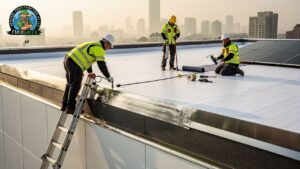
A house size replacement usually takes one to three days and follows one order: strip, repair the deck, insulate, install the membrane, flash, test.
Flat roof installation goes wrong at the details, so each step below is a place to ask for a photo.
- Remove the old membrane and any wet insulation down to the deck.
- Replace soft or stained sheathing.
- Lay tapered insulation so water has a path to each drain.
- Add a vapor retarder if the assembly calls for one.
- Adhere, weld or fasten the membrane, depending on the system.
- Probe every seam and reseal any gap.
- Flash walls, vents, skylights and edges.
- Flood test the drains and confirm water leaves the roof.
Do You Need A Permit To Reroof In Tacoma?
No permit is needed if the old roof is removed, the new material is under 2.5 lb per sq. ft., and the framing stays unchanged.
Laying new roofing over one existing layer is different: the city lists a roof overlay permit, and its over the counter list notes a pre inspection must be completed first.
Owners of commercial flat roofs need a separate strip and reroof permit. Structures with more than six dwellings or more than three stories also go through commercial review. Changing the roofline or framing, which happens when someone wants to add a deck, needs a permit no matter the building type.
Most Common Flat Roof Problems
Water rarely gets in through the middle of the membrane. Most flat roof problems start at seams, flashing and drains, so check those first.
| Problem | What you see | First move |
|---|---|---|
| Ponding | Water standing 48 hours after rain | Clear the drain; ask about tapered insulation if it persists |
| Open seams | Lifted or gapped edges | Clean, dry and reseal with a compatible product |
| Failed flashing | Stains beside walls, vents or skylights | Reseal or replace the flashing |
| Blisters | Raised bubbles from trapped moisture | Cut, dry and patch; scan for wet insulation |
| Moss and needles | Green growth, debris at drains | Remove by hand; pressure washing lifts seams |
| Saturated insulation | Soft spots underfoot, repeat leaks | Infrared scan to map the wet area |
On older flat roofs, the last row is the expensive one. However, wet insulation will not dry on its own under a sealed membrane and each patch placed over it will only cover up the problem.
Flat Roof Leak Repair Process
Find where water enters, dry that spot, patch it with a material that matches the membrane, and test with a hose.
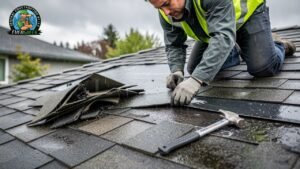
The first step to flat roof repair is a search, as water runs along with the roof before falling down, leaving the stain some distance from the hole.
- Take measurements from two walls to the stain inside then extend those measurements to the roof.
- Work uphill and sideways from that point, checking seams, flashing and drains.
- Dry the area completely. A patch over damp membrane traps the moisture.
- Clean the surface and patch with a product made for your roof. Asphalt roof cement can damage single ply sheets.
- Press out air, seal the edges, then run a hose to test.
Resist stacking thick coats of mastic over a leak. Each coat builds a small dam, and the roof was designed to shed water toward its drains. Small patches typically run $250 to $800 in Tacoma (estimate).
Owners of flat roofs can clear drains and patch a small puncture on a dry EPDM roof with the maker’s kit. TPO and PVC repairs need heat welding, which is a pro job, and so is anything near an edge.
| Situation | Repair | Replace |
|---|---|---|
| Leak location | One spot, one cause | Several spots, or a new one each winter |
| Deck and insulation | Dry after a moisture scan | Saturated or rotted |
| Roof age | Under about 12 years | Near the end of its range |
| Repair history | First or second patch | Invoices stacking up |
Flat Roof Maintenance Schedule
Twice year round, and after large windstorms. In Tacoma, the fall visit is at the beginning of October, prior to rain.
The primary principle of flat roof maintenance is to maintain a flow and trap any opening before the next rainy season makes it a stain on the ceiling.
| When | What to do |
|---|---|
| Early October | Clear drains and scuppers, check seams and flashing, trim overhanging branches |
| Leaf drop, monthly | Sweep debris and check that drains run freely |
| After a windstorm | Look for lifted edges, punctures and fallen limbs |
| Late spring | Look for winter damage, moss and any water still standing |
| Blue Tip: Book the fall check in September. After the first big storm, roofers’ calendars fill and small leaks wait in line. |
Choose A Flat Roof Contractor In Tacoma
Review Washington L&I registration; compare written scopes versus price. GCs require a $30,000 bond, specialty contractors require a $15,000 bond and $250,000 liability insurance.
Ask each bidder:
- What is the manufacturer’s warranty and how is the workmanship warranty?
- How is rotted deck priced?
- Who pulls the permit, if one is needed?
- Will you send photos of each step?
Ask how many flat roofs the crew installs in a typical month, and watch how the office handles change orders. A contractor who dodges that talk before signing tends to create a dispute after. Put three quotes side by side and compare material and thickness, insulation, deck pricing, warranty terms, permit handling and cleanup. A low total with a thin scope is usually the costly one.
| Blue Tip: Ask to see one finished flat roof that has been through two winters, and ask the owner how it has held up. |
Frequently asked questions
What is a flat roof construction manual?
A technical guide for designing, building, and maintaining flat roofs. It covers materials, layer order, slope, drainage, flashing, and repairs.
What is an AI enhanced manual about flat roof construction?
There is no standard product by that name. It usually means a digital manual with an AI assistant that answers questions from its content or helps pick materials and estimate quantities. Always check its output against the manufacturer’s instructions and local code.
Why do architects choose a flat roof?
For clean modern design and usable roof space, such as terraces, solar panels, and equipment. It also suits wide or irregular footprints and can cost less to frame.
What is the primary structure of a flat roof?
The roof deck, made of wood joists with plywood on houses, or steel or concrete on larger buildings. Insulation, the membrane, flashing, and drains sit on top of it.
When is the best time to replace a roof in Tacoma?
Late spring through early fall, when decks stay dry and adhesives and welds cure properly. Call in March or April for summer work.
Are permit rules the same in Tacoma and Puyallup?
Not necessarily. Each city sets its own rules, so check with the city where the building sits before work begins.
Get A Straight Answer On Your Roof
Evergreen General Construction #1 LLC with 25+ years of experience will inspect your roof, tell you whether it needs a repair or a replacement, and put the scope and price in writing. Call (208) 695-3167 or email 1evergreengc@gmail.com.
Sources
- City of Tacoma, Residential Permits: re-roof exemption conditions, overlay permit, and contact number.
- Tacoma Permits, Is a permit required to re-roof a house?: same material replacement, added layers, and roofline changes.
- U.S. EPA, Using Cool Roofs to Reduce Heat Islands: the 50 to 60°F surface temperature figure and the winter heating note.
- Washington L&I, Application for Construction Contractor Registration (F625-001-000): bond and liability insurance amounts.