Skip to content
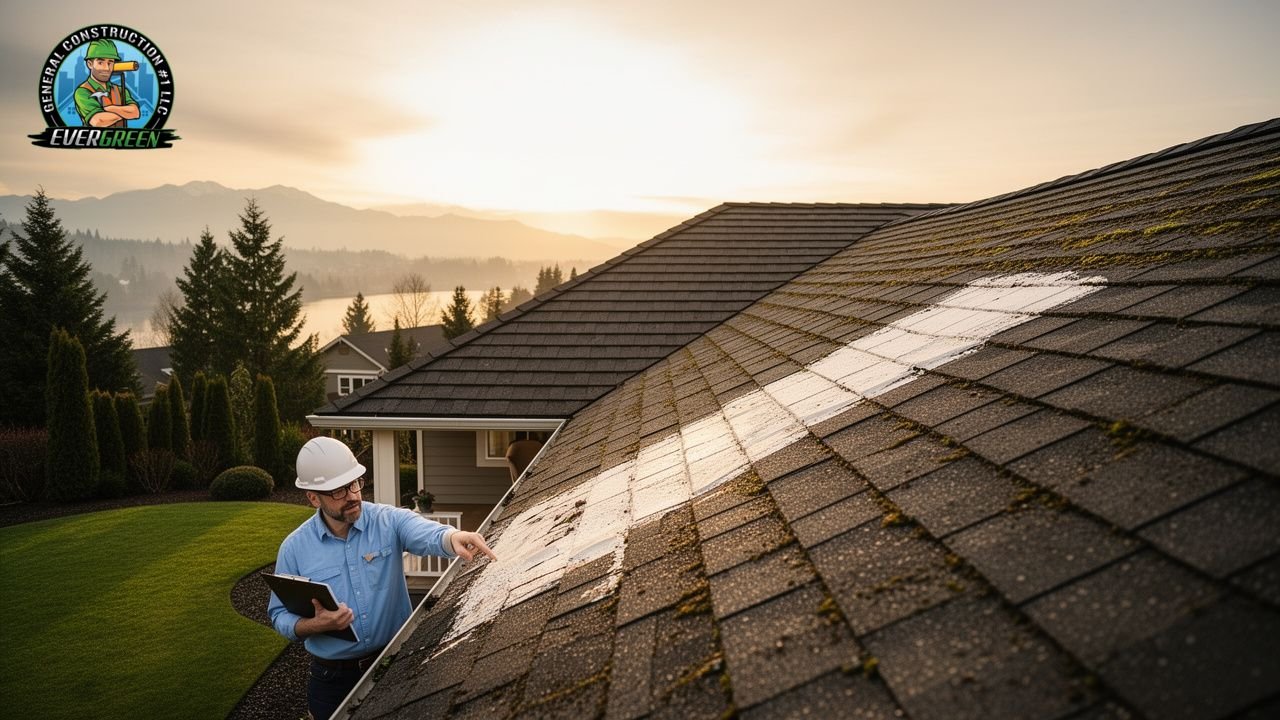
Puyallup homes take a different kind of beating than roofs in drier parts of the country, and a lot of the advice circulating online was never written with our rainfall in mind. Roofing Myths in Puyallup, WA tend to spread because they sound reasonable, get repeated at hardware stores, and rarely get corrected until a homeowner is standing in an attic looking at a water stain.
Evergreen General Construction #1 LLC has worked on enough South Hill, Sunrise, and Meridian Avenue homes as a local Roofing Service to know which of these myths cause real damage and which ones are harmless. Before assuming your roof falls under an exemption, check the City of Puyallup’s building permit requirements, since re-roofing with sheathing replacement requires a permit even on a straightforward single family home.
Roofing Myths in Puyallup, WA
Most of the advice available on the Internet is from Arizona, Texas, and Florida roofers who are primarily concerned about the sun and hurricane winds. Moss colonization, continued moisture, and mild freeze thaw action (causing a few small cracks over winter) are all problems that Pierce County roofs have to contend with.
A Roofing Service built around a dry climate gives you advice for the wrong set of failure points, and that mismatch is where most Common Roofing Myths originate.
Local Roof Maintenance Myths
Moss and Gutter Misconceptions
The biggest Roof Maintenance Myths in this region center on moss. Homeowners often believe a little green growth on the north slope is cosmetic and can wait until the next scheduled cleaning. In practice, moss holds moisture against the shingle mat, and on a roof that gets 175 millimeters of rain in November alone, that moisture has weeks to work into the granule layer before it ever dries out.
A roofing service familiar with Puyallup’s wet season will tell you moss removal in late summer, before the rains return, does far more good than a spring cleanup after the damage is already done.
Gutters get similar treatment. Often, homeowners think that they only experience overflow at the roof line because of blocked gutters. The reality is that water backs up under the initial course of shingles near the eave, and accumulates and rests on the fascia board for days.
On homes shaded by Douglas fir, which describes much of Puyallup’s older neighborhoods, needle buildup clogs a gutter system twice as fast as an open lot would, and a Roofing Service that skips a gutter check during a maintenance visit is missing half the picture.
Attic Ventilation Assumptions
A second common belief is that ventilation only matters for keeping a house cool in summer. In the Pacific Northwest, ventilation does more work in winter, pulling moist interior air out of the attic before it condenses on the underside of the sheathing.
The Department of Energy’s ENERGY STAR program notes that a well vented attic reduces the potential for ice damming and removes the excess moisture that causes rot and mold, a point worth reading directly from their attic ventilation guidance.
A Roofing Service that skips a ventilation check often leaves a homeowner paying for sheathing repairs that airflow alone would have prevented.
Persistent Roof Replacement Myths
Insurance Coverage Assumptions
Plenty of homeowners believe a homeowner’s insurance policy automatically covers storm damage, full stop. Coverage in Washington depends on the cause of loss and the age of the roof at the time of the claim, and insurers often apply depreciation schedules to roofs over 15 years old, so a homeowner might receive a fraction of replacement cost even after a legitimate wind event.
A Roofing Service that documents damage thoroughly, with dated photos and a written scope, changes how an adjuster responds to the claim.
Full Tear Off Requirements
Another one of many Roof Replacement Myths worth addressing is the belief that a new layer of shingles can always go over the old one to save money. Washington’s adopted building code allows overlay in limited circumstances, but doing so hides the condition of the decking underneath, and in a climate where trapped moisture is the enemy, that’s a real risk.
A roof with two layers already on it needs a full tear off before a third can go down, and a careful Roofing Service will refuse the overlay option once a deck shows any history of leaks.
Shingle Roof Myths
Shingle Roof Myths usually start with lifespan claims. This 30 year shingle is rated for 30 years with moderate climate exposure, not the near constant humidity and moss pressure that is prevalent in Western Washington.
In practice, a standard three tab shingle in Puyallup will typically exhibit granule loss and curling at age 18-22, and a well-ventilated architectural shingle roof may achieve or even surpass this rating.
The difference is usually ventilation and moss control, not the shingle brand per se, which is why a roofing service that guarantees a warranty number but doesn’t assess your attic ventilation is missing half the picture.
Another persistent belief is that shingle color has no functional effect here. Dark shingles absorb more solar radiation and reach higher surface temperatures on the handful of sunny August afternoons Puyallup gets, and that thermal cycling, expanding in heat and contracting overnight, contributes to earlier granule loss compared to lighter colored shingles under identical ventilation. A Roofing Service should walk you through that tradeoff before you pick a color off a sample board.
Flat Roof Myths Explained
Flat Roof Myths are important here since a lot of Puyallup properties have a flat or low slope roof on top of a garage conversion, mudroom, or detached shop. An average misconception is the notion that a flat roof is fine as long as water will run off.
While a low slope is required, low slope membranes must be sloped at least 1/4″ per foot to prevent ponding, and ponding water on a modified bitumen or TPO membrane will cause seams to fail prematurely in years. A roof service for a flat roof addition will not only assess the surface membrane but will also evaluate the slope and drainage locations.
Roofing Facts Every Homeowner Should Know
Roofing Facts Every Homeowner Should Know start with the local permitting reality. The City of Puyallup requires a permit for any re-roof involving sheathing replacement on a single family home or garage, and drip edge is required on all roof edges under current code, a detail some out of area crews skip because their home jurisdiction doesn’t require it. A permitted roofing service pulls that permit before work starts, not after an inspector notices shingles going up without one.
A second fact: Puyallup sits in a Csb climate zone, warm, dry summers and cool,l wet winters, with July averaging under an inch of rain and November averaging closer to seven inches. That swing is why a Roofing Service stays busiest in late summer and early fall, scheduling work ahead of the rains rather than during them.
Common Roofing Misconceptions
Roofing Misconceptions about pricing usually come from national average websites that ignore regional labor rates and the extra underlayment a wet climate roof needs. A homeowner comparing a national online estimate to a local bid from a Roofing Service is often comparing two different scopes of work, not two prices for the same job.
Ice and water shield in valleys, for instance, is standard practice here and adds real cost, but it’s the detail that prevents ice dam leaks two winters later.
Timing carries its own misconception. Many homeowners assume any contractor can install a roof safely in the rain if they just work fast enough. Reputable crews stage the tear off in small sections and only expose as much decking as they can dry in and cover before the next band of rain arrives. Understanding the steel roof installation process also helps homeowners see why weather conditions and proper preparation matter during a roofing project, which sometimes stretches a three day job into four or five. That’s not inefficiency. It’s how you keep a house dry during a Western Washington install.
Roof Care Facts
Roof Care Facts for a climate like ours come down to three habits: clearing moss before it establishes each August, keeping gutters clear of fir and cedar needles through fall, and checking ventilation whenever attic insulation is added or disturbed.
None of these require a full Roofing Service visit each time. A homeowner who can safely reach their roof can make the time to clear the gutters and treat the moss, but leave the task of inspecting the gutters and flashing to the professionals, where the error could cost a lot.
Roofing Tips for Homeowners
Roofing Tips for Homeowners who are getting bids should start with one simple ask: request the ventilation calculation for the specific attic, not a generic industry standard. A Roofing Service that can produce that number, based on your actual attic square footage, is thinking about your roof’s real conditions rather than reciting a script.
Ask, too, whether the bid includes drip edge and ice and water shield in valleys, since both are effectively required by local code and their absence in a low bid usually explains the price difference.
A second tip: ask how the crew handles an unexpected rain delay mid tear off. For any roofing service that has been in the business for a full season in the Puyallup area, they will know that the weather here can shift too rapidly for an early morning forenoon to become a full afternoon downpour.
Frequently Asked Questions
What is the typical time for a roof being replaced in Puyallup?
Average single family dwellings in this vicinity require 2-4 days for full tear off and replacement dependent on roof complexity and gaps between rain systems.
Is the roof repairable or replaceable?
Often, yes. If the underlying decking is still structurally sound, it is possible to repair isolated leaks, damaged flashing, or a single area of roof damage caused by storm damage without replacing the entire roof.
What is the difference between architectural and 3 tab shingles?
Three tab shingles are thinner and a single layer, whereas architectural shingles are thicker, layered, have a longer wind rating, and have a more dimensional look.
How often must gutters be cleaned in a wet climate?
Twice a year – in late summer, before autumn rains, and again in late winter – most houses will need cleaning; under heavy tree cover, more often may be necessary.
Does Puyallup need a permit to replace an entire roof?
Yes, when sheathing is involved. The city treats re-roofing that requires sheathing work as permit required residential construction, and permits are generally issued the same business day.
Is moss growing on houses in Puyallup a serious issue?
They can be. Moss is common on north facing slopes throughout Pierce County because of the shade provided by the large canopy of the trees, and because of the consistent moisture during the rain season.
Which rooftop material is the most weatherproof, as it relates to rain and moss pressure?
For most houses in this climate, architectural asphalt shingles with correct ventilation and zinc or copper near the ridge to prevent re-growth of moss are generally satisfactory.
Is it really the best time of the year to schedule roofing projects in this area in the fall?
Generally yes. The longer dry periods are in late summer and early fall before November and December bring heavier rains, allowing crews to work with more consistency.
Get an Honest Roof Assessment
If you’re weighing a repair against a full replacement, or you just want someone to walk your attic and tell you the truth about your ventilation, Evergreen General Construction #1 LLC offers an honest Roofing Service built around Puyallup’s terrain and tree cover. Call (253) 627-1025 or email 1evergreengc@gmail.com to schedule an inspection before the next wet season settles in.
Sources
- City of Puyallup, Building Permit Applications. Official city guidance on which residential projects, including re-roofing with sheathing replacement, require a permit and how the over the counter permitting process works.
- ENERGY STAR, U.S. Department of Energy and EPA, About Attic Ventilation. Federal guidance explaining how balanced attic ventilation reduces moisture buildup, prevents ice damming, and protects roof shingles and sheathing over time.
- NOAA National Weather Service climate normals for Western Washington. Regional precipitation and temperature data used to characterize Puyallup’s wet season timing and seasonal rainfall totals referenced throughout this guide.
- Washington State Building Code Council, 2021 State Amendments to the International Residential Code. State level code provisions governing re-roofing, overlay limitations, and required roofing details such as drip edge installation.